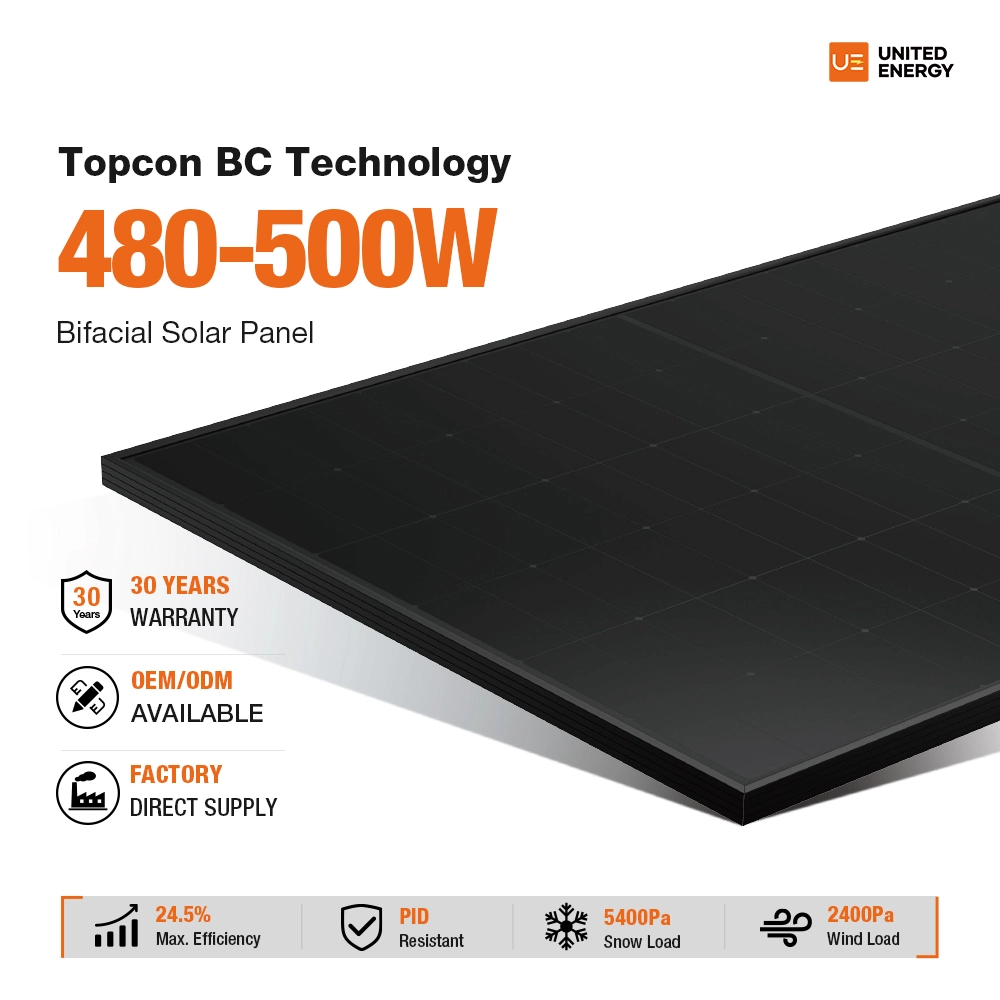
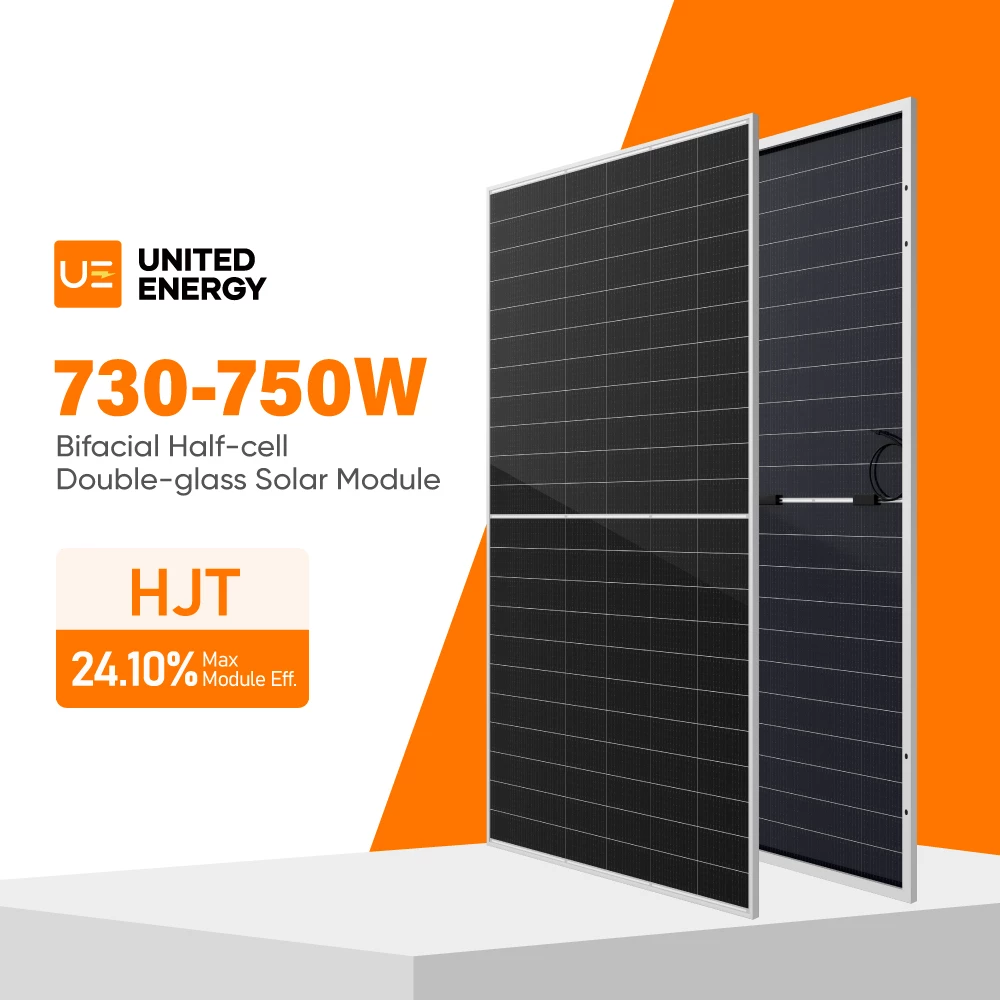
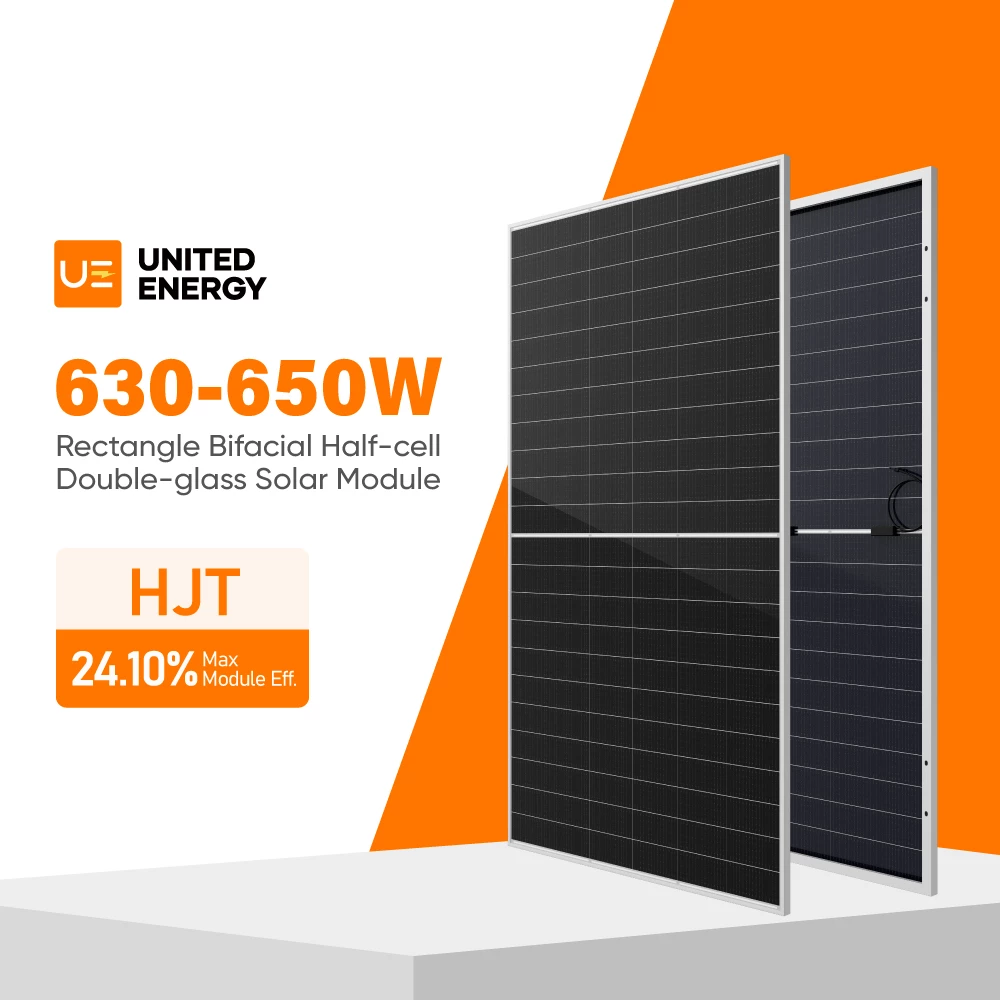
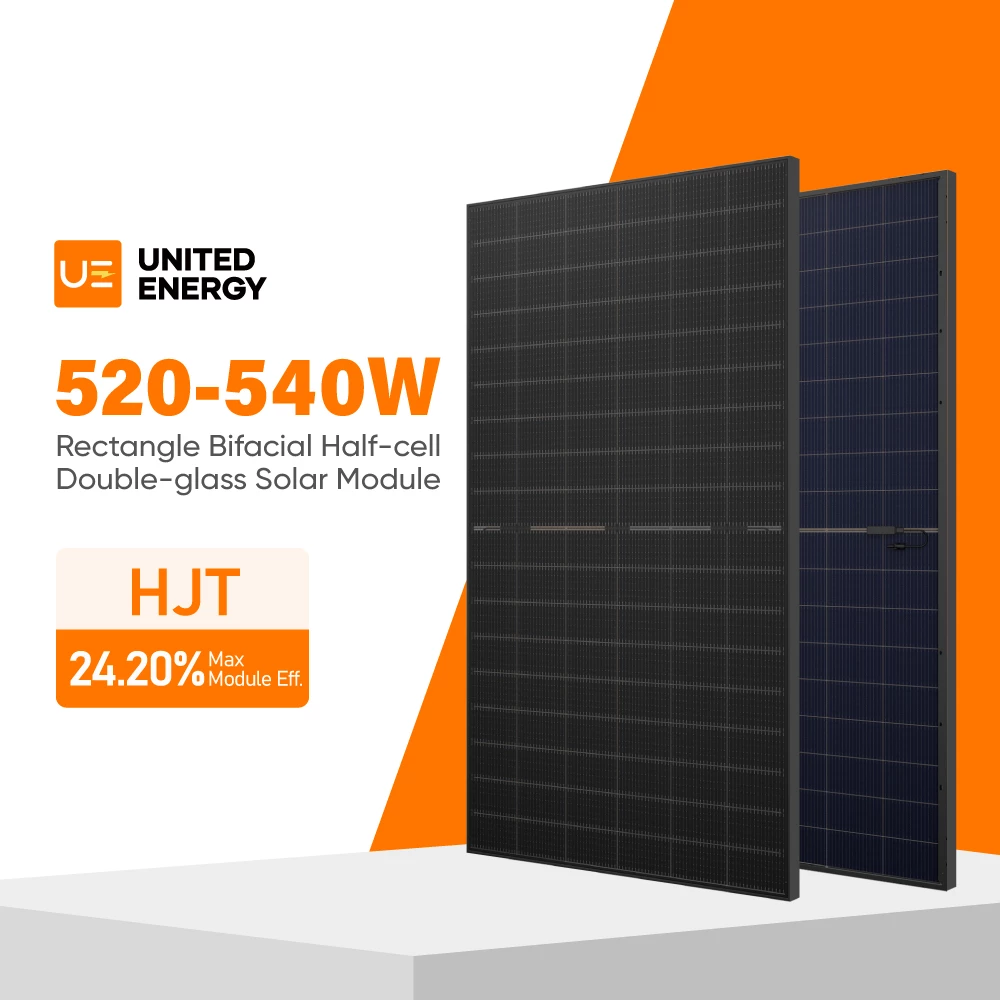

📖 Product Details
The 210mm Titan for Gigawatt-Scale Dominance
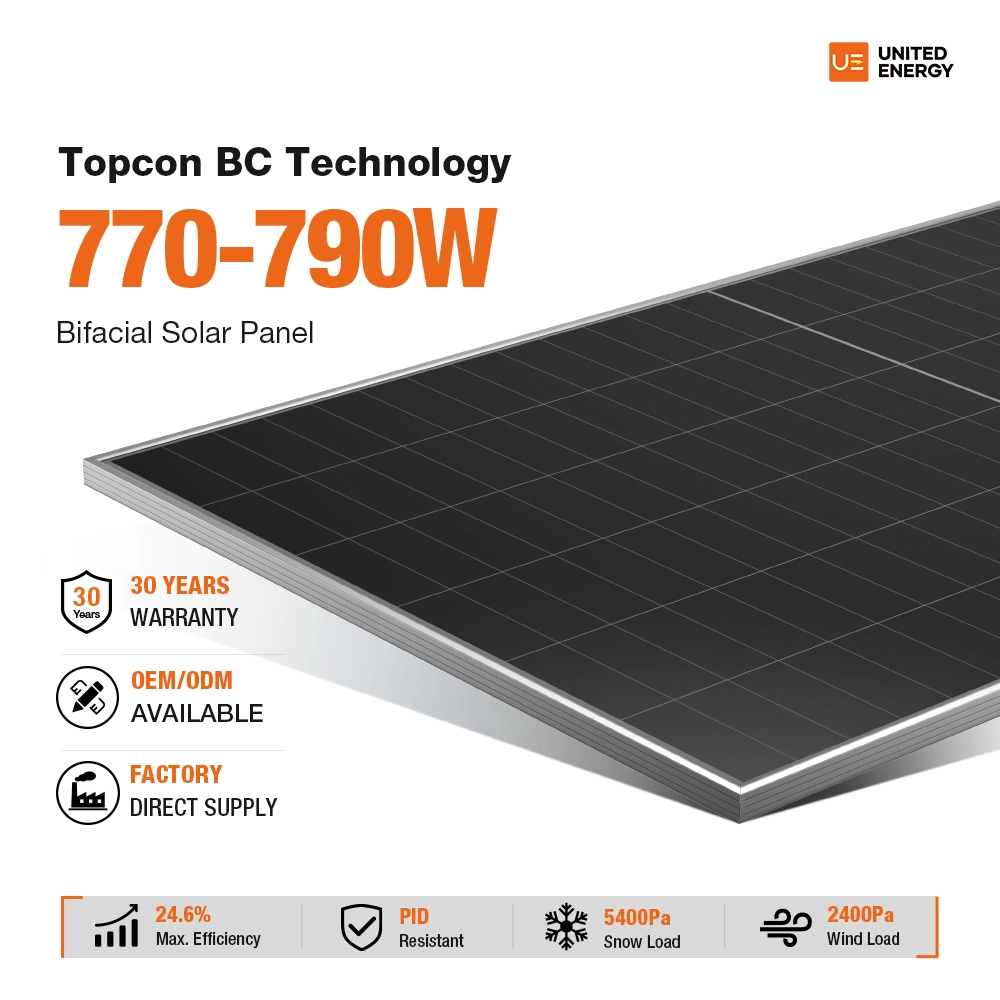
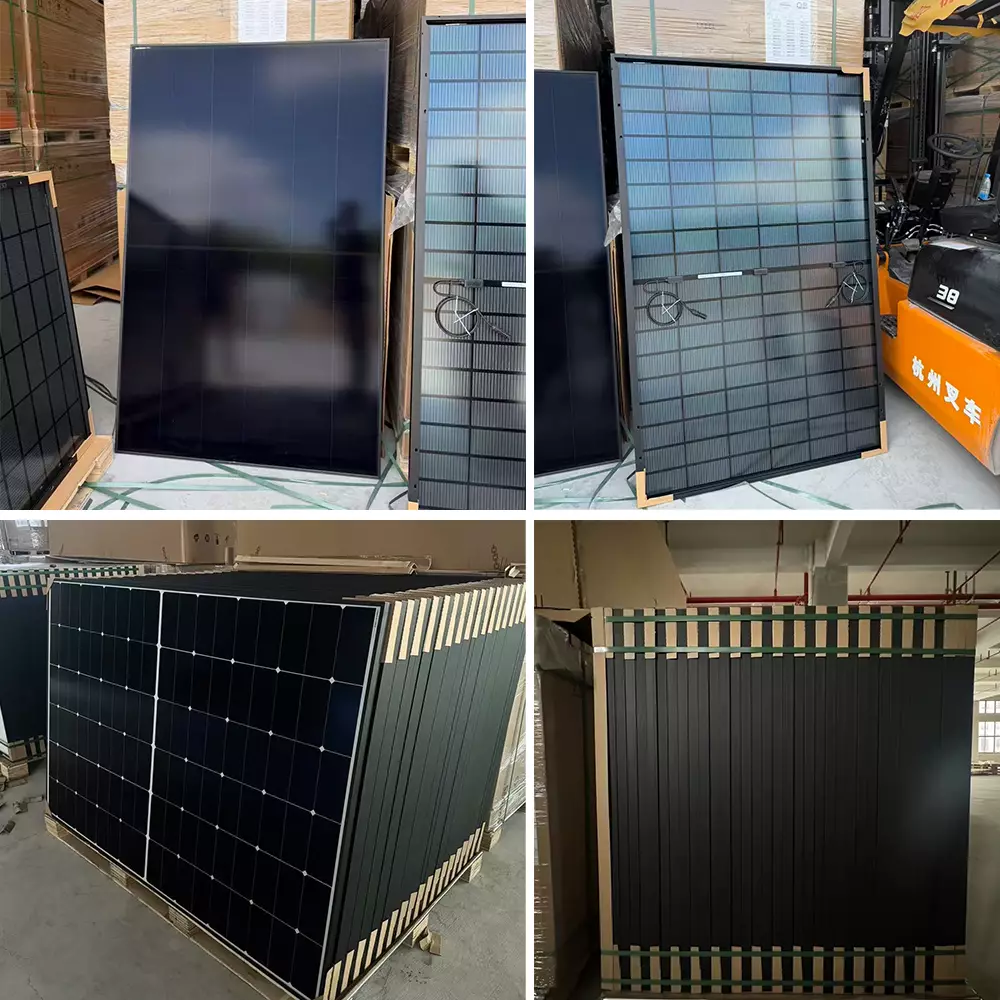
The UE795B-78HBD 795W BC PV Module is engineered for developers who need to squeeze every last drop of ROI from their land. By utilizing 156 (6×26) large-format 210*210mm cells, we have expanded the module dimension to 2465×1303×33mm, unlocking a colossal 795W output. Fewer modules mean significantly less racking, faster installation with automated machinery, and drastically reduced labor and material costs on site.
Unprecedented 75% Bifacial Gain
Featuring an upgraded dual-glass structure with a 75±5% bifaciality ratio, this giant outperforms standard bifacial panels. When mounted on high-clearance trackers over highly reflective surfaces, the rear side captures more scattered light, pushing the effective power output even further, improving your project's Internal Rate of Return (IRR).
Built for the Harshest Environments
Constructed with dual 2.0mm high-transparency semi-tempered glass, an IP68-rated junction box, and a heavy-duty anodized aluminum frame, this module is highly resistant to PID, salt mist, and ammonia. The double-glass design inherently prevents micro-cracks during transportation and installation, ensuring a 30-year operational lifespan in the world's most extreme climates.
💡 Core Selling Points
- 👑 The Ultimate Power Titan: Approaching the 800W milestone, the UE795B-78HBD drastically reduces the number of modules, strings, combiner boxes, and DC cabling per MW.
- 💎 210mm Wafer Platform: Employs the largest mainstream 210mm cells to maximize active surface area and energy density for vast utility-scale arrays.
- ☀️ Unmatched 75% Bifaciality: An upgraded 75±5% bifacial ratio captures maximum rear-side albedo, significantly boosting yield on trackers, sand, or snow-covered terrains.
- 🌗 Superior Shading Tolerance: Advanced Back Contact (BC) technology moves gridlines to the rear, eliminating front-side shading and maintaining high performance under complex shading conditions.
- 🛡️ Mega-Structure Reliability: Built with dual 2.0mm semi-tempered glass and a reinforced anodized aluminum frame (39.8kg), bearing extreme static loads (Front 5400Pa / Back 2400Pa).
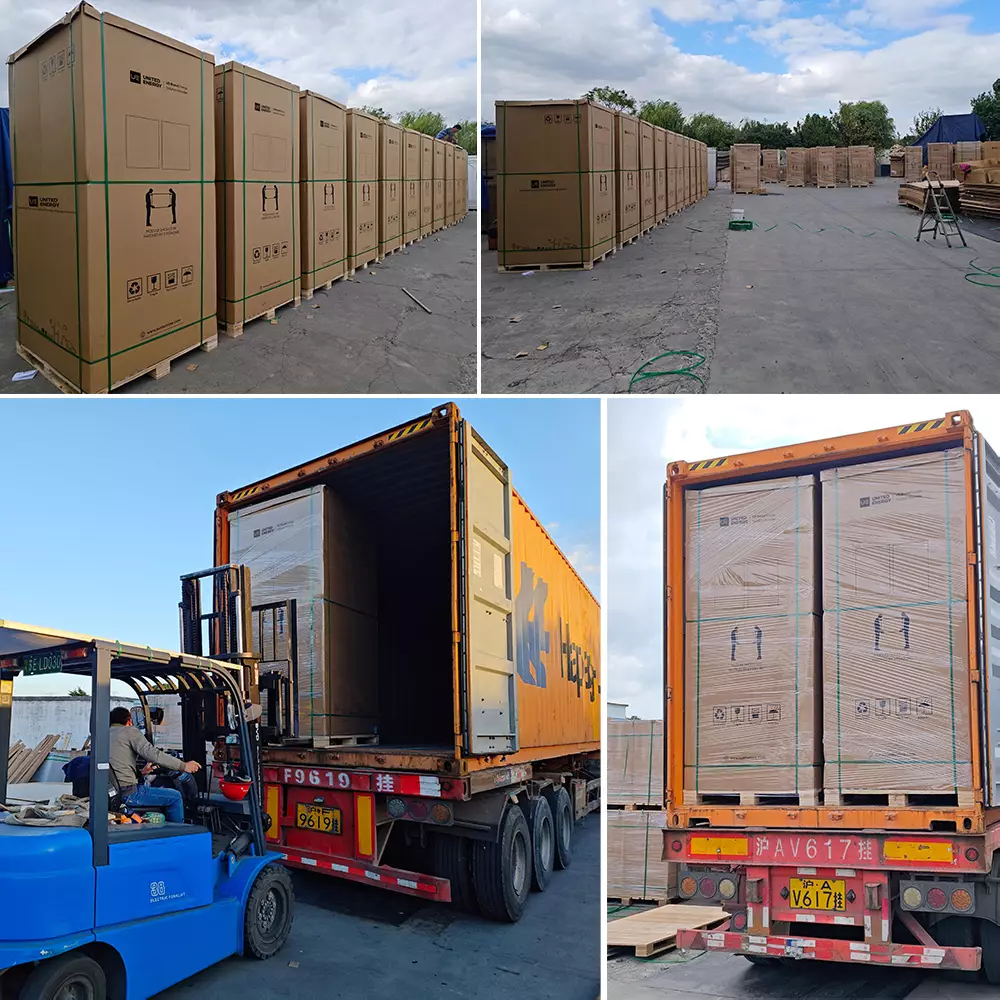
- 🚢 High-Density Logistics: The massive size reduces the module count per project, and with 594 pcs per 40' HQ container, shipping costs per watt are pushed to the absolute minimum.
- ⏳ 30-Year Bankability: Backed by a 15-year materials warranty and a 30-year power warranty (First year 99.00%, ≤0.38% annual degradation).
📊 Technical Specifications
1. Electrical Parameters (STC*)
STC: Irradiance 1000W/m², Cell temperature 25℃, AM1.5. Power measurement tolerance: ±3%
| Maximum Power (Pmax/W) | 775 | 780 | 785 | 790 | 795 |
|---|---|---|---|---|---|
| Module Efficiency (%) | 24.10 | 24.30 | 24.40 | 24.60 | 24.80 |
| Open Circuit Voltage (Voc/V) | 58.82 | 58.92 | 59.02 | 59.12 | 59.22 |
| Short Circuit Current (Isc/A) | 16.71 | 16.78 | 16.85 | 16.92 | 16.99 |
| Voltage at Max Power (Vmp/V) | 48.87 | 48.97 | 49.07 | 49.17 | 49.27 |
| Current at Max Power (Imp/A) | 15.86 | 15.93 | 16.00 | 16.07 | 16.14 |
2. Electrical Parameters (NOCT*)
NOCT: Nominal Operating Cell Temperature, Irradiance 800W/m², Ambient 20℃, Wind 1m/s
| Maximum Power (Pmax/W) | 588 | 592 | 595 | 599 | 603 |
|---|---|---|---|---|---|
| Open Circuit Voltage (Voc/V) | 55.77 | 55.87 | 55.96 | 56.05 | 56.15 |
| Short Circuit Current (Isc/A) | 13.46 | 13.53 | 13.59 | 13.66 | 13.72 |
| Voltage at Max Power (Vmp/V) | 46.46 | 46.55 | 46.65 | 46.74 | 46.84 |
| Current at Max Power (Imp/A) | 12.65 | 12.71 | 12.76 | 12.82 | 12.87 |
3. Mechanical & Operating Characteristics
| Parameter | Specification |
|---|---|
| Cell Type & Size | TOPCon BC, 210 * 210 mm |
| No. of Cells | 156 (6×26) |
| Dimension | 2465 × 1303 × 33 mm |
| Weight | 39.8 kg ±3% |
| Front / Back Glass | 2.0mm high-transparency / 2.0mm semi-tempered glass |
| Frame | Anodized aluminum alloy |
| Junction Box / Diode | IP68 / 3 |
| Output Cables | 4mm², (+)300mm, (-)200mm, or Customized |
| Maximum Static Load | Front 5400Pa / Back 2400Pa |
| Maximum System Voltage | 1500V DC (IEC) |
| Maximum Series Fuse | 30A |
| Bifaciality Ratio | 75±5% |
| Fire Rating / Safety | Class C (IEC) / Class II |
| Packaging | 33 pcs/pallet, 594 pcs/40' HQ |
4. Temperature Characteristics & Certifications
| Parameter | Specification |
|---|---|
| Operating Module Temperature | -40℃ to +70℃ |
| Nominal Operating Temperature (NMOT) | 42±2℃ |
| Temperature Coefficient of Pmax | -0.26%/℃ |
| Temperature Coefficient of Voc | -0.22%/℃ |
| Temperature Coefficient of Isc | +0.05%/℃ |
| Certifications | IEC 61215, IEC 61730, UL 61730, ISO9001:2015, ISO14001:2015, ISO45001:2018, IEC62941 |